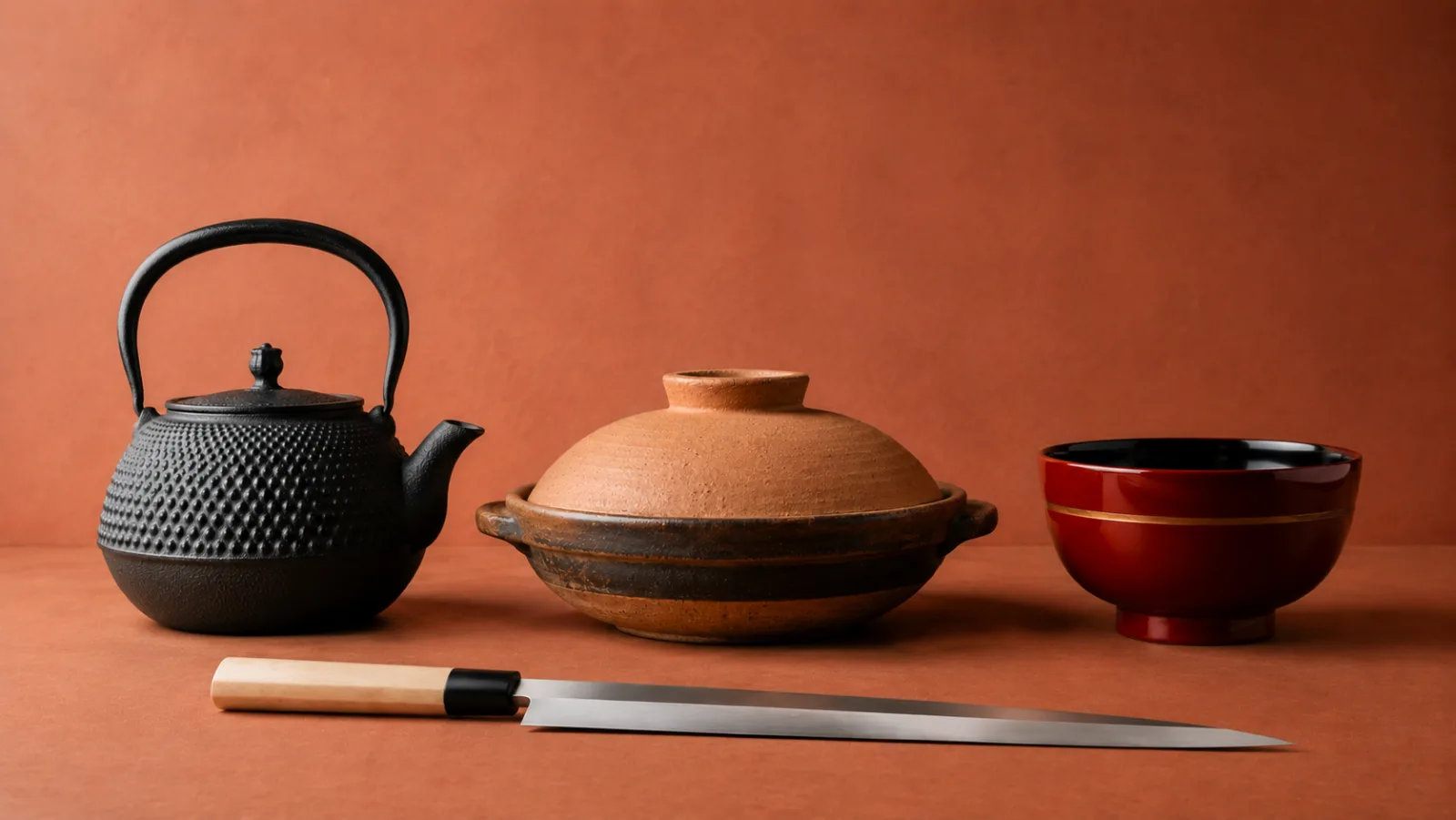
The part the listing leaves out.
Japanese craft objects are sold worldwide with beautiful photographs of the outside and very little about what will destroy them. These guides cover the differences that cost people the piece — each one checkable, each one sourced.
Already own one? Check what will destroy it — answer one question about the object in your hands and get the answer without reading a guide.
All the guides
Agarwood: the fake has a tell
Oud in the Gulf, jinkō in Japanese incense — one material. The resin forms only after a mould infection, so pale light wood sold as agarwood never went through it. CITES Appendix II since 1995.
What a whetstone grit number does not tell you
The grit number is not a measurement you can compare across makers — there is no dominant standard behind it, and it describes the finish as much as the particle size. What to buy anyway.
The board decides how long the edge lasts
A thin hard edge chips, and the board is what it meets every cut. Glass and steel damage edges rapidly; wood closes its own shallow cuts. Within wood, grain and pore size decide, not the word hardwood.
Santoku, gyuto, bunka, nakiri — and which is handed
Santoku and bunka are one knife with two tips. The pair that actually differs is nakiri and usuba — they look alike, but one is double-bevelled and the other is handed.
Washi: what the word covers
Kozo fibre averages 9.4 mm where poplar pulp averages 1.5, and a prefectural paper centre names that ratio as the reason washi behaves as it does. But the standard applies the same word to machine-made chemical pulp, and says so itself.
A matcha whisk is one piece of bamboo
Carved from one piece of bamboo, so a broken tine ends it. And "80 tines" is not a grade above "60" — it is a whisk built for thin tea. Plus the two water mistakes that make one go mouldy.
Goat hair or synthetic, for a Kumano brush
A natural-hair brush and a synthetic one are built for different products, not ranked by price. Pick by whether you mostly use powder or cream — and dry it standing up, or the ferrule glue goes.
“Ceremonial grade” is not a standard
ISO 20715 and Japanese food labelling define matcha by process — shade-grown, unrolled, stone-ground. Neither defines “ceremonial” or “culinary”. And bright green is not proof of shading.
A single-bevel knife is made for one hand
Yanagiba, deba and usuba are ground on one side only. In the wrong hand the blade is not blunt, it is backwards — and the left-handed version is made to order.
White steel or blue: which carbon steel
Blue steel is white steel with chromium and tungsten added — longer edge life, harder to bring back. Professionals who sharpen daily prefer white, which tells you the trade-off is about you.
Rust or patina: which one are you looking at
A discoloured carbon blade is showing you one of two things: a protective oxide layer, or damage. They look similar, and polishing off the wrong one returns the knife to its most vulnerable state.
What HRC on a knife listing buys you
Hardness is not a score. It is what allows a thinner edge — and the thin edge is what makes it fragile. Above 60 HRC a steel rod risks chipping the apex.
A chipped knife: cause, and what repairs it
A shallow edge angle is what makes a Japanese knife sharp and what makes side force chip it. The fix is a coarse stone and lost blade height, not glue or a finishing stone.
Giving a knife: the belief, and the coin
A widespread belief holds that a gifted knife severs the relationship — and the customary remedy is that the recipient gives a coin back, making it a purchase. Costs nothing to observe.
The handle: porous, replaceable, sometimes handed
A wa handle is ho wood friction-fitted to a hidden tang: porous, so keep it dry, and replaceable because it was never bonded. The D-shaped section is handed, which is where handedness appears twice.
Mould on a bamboo steamer, and the answer English guides skip
English guides treat mould as something you scrub off, and the routine starts by soaking the basket — the one step a Japanese seiro maker calls strictly forbidden. Neither raises the other answer: that the basket may be finished.
What destroys lacquerware
Dishwasher, microwave, sunlight. All of them normal things to do with tableware, all of them irreversible on urushi.
Is urushi safe to eat from?
The liquid is an allergen; curing polymerises it into a hard waterproof film, and once hardened reactions are possible but less common. Which makes damage — chips, wear — the part that matters.
Urushi and bacteria: what was actually measured
Lacquerware is sold as naturally antibacterial, and for once there is a public measurement behind it: eleven urushi films, JIS Z 2801, most below the detection limit. Origin and finish made no difference — additives did.
Is a Damascus knife real? The word changed
No knife made today is Damascus in the original sense; production ended around 1900. Since 1973 the word has meant pattern-welded steel, and modern steelmaking left the pattern purely cosmetic.
What a donabe is actually doing
A prefectural laboratory measured four donabe off the market: 0.7 to 0.9 W/m·K, and fracture toughness it calls quite low. One property explains what the pot is for and every rule that comes with it — and the four scored more than two to one apart on thermal shock.
The step before a new donabe cooks anything
Unglazed clay is porous. Used straight from the box it seeps, stains and holds odours — and the fix is one simmer and a bowl of leftover rice.
Why a donabe does nothing on induction
An induction hob heats metal, not clay, so an ordinary donabe never warms up on it. No setting fixes it, and the pot cannot be converted — but induction-ready ones exist.
What is actually in a kintsugi kit
Kintsugi means urushi lacquer with precious metal powder. The curing instructions give a kit away regardless of the description — and the food-safety question is one this site will not answer from silence.
Eating from a kintsugi repair: what actually decides it
Two Japanese sources — a kintsugi school and a repair business — put the question not on urushi against epoxy but on whether the material states compliance for food contact, and on a stated heat limit. What to check, and what they suggest when you cannot.
Japanese chopsticks: the point, and two gestures
Japanese chopsticks taper to a point; Chinese are blunt, Korean flat-handled. And two table gestures echo funeral practice, which is why they land harder than ordinary bad manners.
Sumi or India ink: the binder decides
Both are soot, and they behave differently once dry. India ink forms a waterproof layer without a binder; sumi depends on animal glue. So “is it waterproof” is a question about the ink, not the word.
Porcelain and the dishwasher: where is the pattern
Underglaze is covered by the glaze and completely durable — one continuous sheen across the piece. Overglaze sits on top of that fired glaze, added in a second low firing. Gold is always on top.
Tetsubin or tetsu-kyusu?
Two Nambu cast iron vessels that look identical from outside. One boils water and gives you iron; putting the other on heat cracks its lining for good. You can tell them apart in one look.
Rust inside an iron kettle: the fix people look for is the damage
Red spots inside a new tetsubin are normal by about the fifth day, and the Nambu ironware association tells owners not to wipe, wash or scrub them away. What to judge instead, and the two remedies the Japanese sources give.
How much iron does an iron kettle actually give you?
78 to 98% of the iron dissolved from cast iron is the readily absorbed ferrous kind — that part is published. How much a kettle of boiled water gives you is unmeasured, which is why a Japanese laboratory started collecting it in July 2026.